contact Michelle

For more information about any resources I have to offer, please contact me here!  I'd love to hear from you!


Portland, OR
USA

It’s my joy and honor to equip dads with practical tools to better dial into their daughters’ hearts.

With 25 years of experience as a licensed professional counselor and over 35 years working directly with teens and young adult women. Dr. Michelle Watson brings practical wisdom to dads with daughters of all ages.

Page Header 2a.jpg

BLOG

Filtering by Category: Navigating Emotions

3 Ways a Dad Can Calm His Daughter's Anxiety

Michelle Watson

Anxiety is a common thing. We all experience it in differing amounts depending on our comfort level in various situations, ranging from unsettledness before a dental procedure to the surge of emotion we feel when pulled over by a police officer as the siren blasts and lights flash.

As a mental health clinician, I’ve been addressing anxiety as a typical stressor in my clients' lives for over 27 years. Some people describe feeling anxious as being caught in a strangle hold that suffocates and doesn’t let go. Others say it’s like having a heavy weight on their chest. And when you add in the accompanying recurring intrusive thoughts with anticipation of future threat, coupled with physical symptoms such as a rapid heartbeat, sweating, nausea, dizziness, and trembling, you can see why this all-encompassing intense reality doesn’t have a quick fix.

Speaking from personal experience, I started dealing with debilitating anxiety around the age of 8 or 9 that resulted in avoiding sleepovers with friends, not going to summer camp because I didn’t want to be away from home, and fainting in a doctor’s office when told that I might need to be hospitalized if my fever didn’t break by morning. Yet back in the 60’s no one called it anxiety; instead, it was simply called “fear.” Sadly for me, I believed that my fear was a sin so I felt shame that I wasn’t allowing God to win my emotional battles.

I wish I knew then what I know now, which is that anxiety is a normal physiological response to stress. Anxiety is an alert system in our body that tells us we need to attend to something when that thing or a person doesn’t make us feel safe or secure.

I wish I knew then what I know now about the effectiveness of lowering anxiety through dietary changes, exercise, even medication.

And one other thing I wish I knew then that I know now is that resolution doesn’t come by just simply pushing through it, trying to ignore it, or even quoting Scripture verses. Yes, these proactive strategies can be helpful, but typically they aren’t effective until one’s body experiences calm and peace (a.k.a., return to homeostasis/equilibrium) before activating these resources. That’s where it helps to have someone in our corner with us when we’re overwhelmed.

A recent study in JAMA Pediatrics (Journal of American Medical Association) reported that between 2016 and 2020, there was a 29% increase in youth anxiety with eight million American kids noted as suffering from anxiety. I believe these numbers are low due to the kids who are unaccounted for in these reports. I would easily say we could double these numbers.


For you as a dad who wants to better understand your daughter, it could be beneficial to know (and perhaps share with her) that we have a national organization called the Anxiety and Depression Association of America, which reveals something about the current distressed state of our fellow citizens. They claim that:

  • Anxiety disorders are the most common mental health condition in our country.

  • Women are twice as likely to be affected by anxiety disorders than men.

  • Girls between the ages of 10 and 18 are more prone to anxiety disorders, most presumably because of hormonal changes.

I love this quote by Dr. Margo Maine where she says that “statistics are people with the tears wiped away.”

This leads me to ask: Is your daughter one of those people represented in these stats on anxiety?

If you’ve never talked to her about it, now is the time.

As a man of action who is ready to help calm your daughter’s anxiety, here’s your three-fold strategy for making that happen:

1. Listen.

This is where she talks and you listen. Even more, this is where you ask questions that allow her to process what’s going on inside her, things she may not even realize are weighing her down. This isn’t the time for lectures, criticism, or course correction. Instead, start with giving her a safe place to land by creating a compassionate space for her to vent and express.

[I’ve attached a set of questions here that you can use to open up a conversation on what’s making her feel anxious. These are from my latest book, Let’s Talk: Conversation Starters for Dads and Daughters and here’s a link to buy it to keep the dialogue with your daughter going strong -- https://amzn.to/3fDAhZd]

2. Hug.

Especially during stressful times, find a way to give your daughter hugs so she feels wrapped in your safe arms when she’s overwhelmed with life. And this isn’t just my opinion; it’s actually backed up by research, which states that when we give or receive a hug it releases oxytocin in our brains, an antidote to the effect of cortisol, the stress hormone.

3. Write.

Quick story: Today in a counseling session an adult woman read me a love note her dad wrote her when she was in college and it brought tears to her eyes as she read it. This story is all the more powerful because she lost him only a few months ago. Now his written words carry even more meaning. I watched the smile on her face shine brighter as she held her dads words in her hands. Take time today to put your love into written form (a text is great, but a note in your handwriting is even better) to let your daughter know you care, you’re praying for her, believing in her, and in her cheering section.

I believe that anxiety immediately decreases by at least fifty percent when someone steps into our distressed space with us.

Dad, you were made with broad shoulders and as you get close to your daughter during her intense times such that she feels your support (even if she’s extra emotional and extra reactive…especially to you), you give her a forever gift because she’ll always remember that you were in her emotional storm with her.

What a Dad's Tears Tell His Daughter (Guest Blog By Randell Turner, Ph.D.)

Michelle Watson

[Today I have invited a fellow counselor and father mentor to share his thoughts on the power of a dad’s “allergies”—a.k.a. tears—in his daughter’s life. Being a dad of two daughters, I trust that his insights will positively impact the way you view tears.]


Like most men in America, I get uncomfortable when someone begins to cry. Be it one of my daughters, a close friend, or even watching someone cry in a movie or on television?

Why is it like that for most men?

For me, it had a lot to do with how I was raised—who my heroes and mentors were growing up. I learned early that the men I admired didn’t cry. After all, James Bond, Dirty Harry, or the Duke didn’t cry, and neither did any “real men,” like my father.

Nor did my sports role models, like Alan Page, Jack Lambert, Mean Joe Greene, and Mike Singletary. These legendary gridiron heroes of my generation were tough as nails. Every Sunday, I cheered each punishing tackle these men inflicted upon their opponents. All the while, it shaped my view of how a real man is supposed to act and feel: tough, powerful, in control, never showing weakness to anyone, no matter how much it hurts.

But life does hurt, sometimes profoundly.

Yet as little boys, we are taught not to shed tears early on. We heard frequent phrases like, “Get up! You’re not hurt; brush it off,” or “Big boys don’t cry,” or one of the most influential childhood quotes: “Stop crying or I will give you something to cry about.”

As a result, we grow up embracing the mantra, “NEVER let them see you cry!” And so we don’t.

As a matter of fact, as young men, especially during our teen years, we often take pride in not crying.

We’ve adopted the view that tears are feminine, a sign of weakness; therefore, they become very uncomfortable. Furthermore, the mentoring men in our lives tended to only express tears at funerals or on rare special occasions like at a daughter’s wedding. Therefore, tears were relegated to infrequent and often confusing emotional expressions.

Year after year, we have stuffed our true feelings into the deep self-made dungeons until only a national crisis will breach its guarded gate.

Unfortunately, we didn’t realize that “unshed tears become a stagnant pool that pollutes our soul.” As a result, now we know that stuffing our emotions has detrimental effects on relationships, especially with our wives and children.

Moreover, it keeps us from being honest with ourselves and others. We often mask our hurt and potential tears with anger because anger helps us keep a lid on our emotions, maintain “manly” control, and allow us to stifle any tear.

But it doesn’t have to and shouldn’t be that way.

Not that we need to become a bunch of blubbering basket cases, but we do need to be courageous enough to express our true feelings to our family and those closest to us.

Tears represent the heart and the essence of what makes us human. To put a lock and key on our emotions is to bury a crucial part of who we are.

When we don’t allow ourselves to dig deep into our emotions, it robs our relationships of true intimacy and growth born out of shared feelings.

The tears shed by our wives and children, and especially those of our daughters, represent and express:

  • A crucial part of who they are

  • A truly transparent heart

  • Happiness, frustration, hurt, connection, learning, attachment, broken hearts, joy, and emotional overload

The language of tears is often saying: “I need you to stop and spend some time with me,” “Share this moment with me,” or “Don’t feel like you have to fix anything, just hold me while my heart heals.”

That is the truth that our tears tell; they represent the heart’s most profound thoughts and feelings.

That’s the truth I challenge all men, young and old, to embrace.

Even if your daughters don’t know how to tell you this directly, they want you to share your heart’s thoughts and feelings. Not just on special occasions and not necessarily every day, but consistently, honestly, and openly in our homes. Allow this honest expression of emotion to draw you closer to your daughters; stop burying an essential part of who you are.

Learning a new language is challenging, but well worth the work. Learning the language of tears can bring you closer to your daughter, as well as your family, spouse, and all of your children.

And it can help you be more honest with yourself. Every challenge has its risks, but with great risk also comes great reward. Are you courageous enough to embrace this challenge? I hope so, and so do your daughters.

Randell Turner, Ph.D. is an author, counselor, and a pioneer in the men’s and fatherhood movement. He has dedicated over 20 years in working with men who feel broken, rejected, isolated, and lonely because of their struggles with “intimacy ignorance.” Randell lives in Wisconsin and has two daughters and seven grandchildren. For more information, check out his website: TransformingFamilies.org.

Is Your Unattended Baggage Hurting Your Daughter? (Guest Blog by Marc Alan Schelske)

Michelle Watson

Marc Alan Schelske is a friend I greatly respect and admire. Today as you read his guest blog, you as fathers will no doubt be inspired by his profound insights to help you relate in healthier ways to your daughters.
- Michelle

That morning I got up early, hoping to enjoy some quiet before family and work obligations kicked in. I shuffled to the kitchen to brew myself some Earl Grey.

In the darkness, my shin collided hard with some unseen obstacle. I tripped and threw out my arms, catching myself as I fell against the wall. My impediment crashed across the hardwoods setting the dog to barking. That woke up the rest of my family.

Bruised, frustrated, annoyed at the dog, I switched on the light to see what had been so irresponsibly left in the hallway. There it was. The blue carry-on baggage that belonged to me.

The week prior I had made a quick weekend flight for a writer’s event. I flew home to a schedule already overfull. Jumping right into the rush of my week, I left my baggage unattended in the hallway, where it sat, waiting to trip some unsuspecting family member. Luckily it was me!

Unattended Baggage Can Be Dangerous

You’ve heard that recorded message that comes over the airport public address system, the one that warns about unattended bags? The airport officials are trying to protect against terrorism threats, but apparently unattended baggage can be a real terror in other ways.

This isn’t just a problem at the airport. Apparently it’s a problem in my hallway. It’s also a threat to our relationship with our daughters.

The truth is that all of us dads have baggage we’ve never unpacked. Our hearts carry wounds that have scabbed over with time but have never received the proper healing.This baggage is just sitting around waiting for someone to trip over it. If we’re not careful, it’s going to be our daughters.

How Does This Baggage Show Up?

Coming back from my trip, I quickly fell back into my routine. The luggage I’d not had time to deal with got pushed to the side of the hallway and quickly faded into the background. I forgot it was there until my shin cracked into it.

Our emotional baggage is much the same. Regardless of what trauma or pain we’ve experienced in the past, we find a way to make life work.

For some of us, the wounds are so deeply buried, that we don’t think of them—and that seems almost the same as if we had dealt with them. We seem fine.

So, can we know if we’ve got untended baggage before it’s too late? Sure! There are three clear flags. If these are present in your life in an ongoing way, you’ve got unattended baggage.

1) Unexpected Outbursts

I noticed my unattended baggage when my shin sent it careening down the hall, waking up my whole family with an unexpected crash. That’s often how our emotional baggage surfaces too. Unexpected, loud and painful.

A common example of this is a dad’s Zero-to-Rage speed. Scripture counsels us to be slow to anger, and yet many speed past that instruction. You can call it a short fuse. 

You can blame it on your daughter’s disrespect or poor listening. But nobody is responsible for your burst of anger except you. If unexpected anger bursts in on us, boiling over in angry words, name-calling, blaming language or worse, that’s a flag that we have baggage that needs to be unpacked.

2) Outsized Responses

When my baggage crashed across the floor, and the dog started barking, the whole ordeal was far noisier than it needed to be. Similarly, emotional baggage often surfaces with a much bigger “crash” than seems reasonable.

If your daughter does something irritating or forgets some small responsibility, how do you react? Think about the tone of voice you use, the type of language you employ, the level of consequence you apply.

If what she did, objectively, weighs in at about a 4 or 5 in terms of seriousness, but the intensity of your response to her is more like a 9 or 10, that’s an outsized response. Maybe you pride yourself on being a strict parent, or “not taking any garbage.”

Well, consider the possibility that your intensity has nothing to do with your daughter, or with wanting to “run a tight ship.” It’s possible that you are inflicting emotional intensity on your daughter that doesn’t belong to her. Regular outsized responses are a flag that you have baggage that needs to be unpacked.

3) Hidden Hazards

In the dark that morning, I couldn’t see my luggage in the pathway. Because I couldn’t see it, I couldn’t avoid running into it. 

Emotional baggage is often invisible in the same way. Sometimes it’s invisible to you. Often, it’s invisible to your daughter.

She’s just going her life, being a kid. She doesn’t understand one particular thing might rub you the wrong way. She probably doesn’t get why you have so much energy around a particular behavior. In her mind “it’s not a big deal.” In your mind, it’s suddenly everything.

If interacting with you is a “minefield,” full of hidden hazards, that’s a flag that you have unattended baggage that needs to be unpacked.


Don’t Give Your Daughter Your Baggage!

The whole incident with the luggage in the hallway could have easily been avoided. All that was needed was for me to take responsibility. Instead of leaving my bag unattended and packed in the hallway, I could have taken the time to unpack it and put it away.

When we don’t take responsibility for our emotional baggage, it often becomes someone else’s problem. Our denial ends up hurting people we love. Then, our baggage becomes their baggage.

As dads, one of our chief responsibilities is to set up our children for the best possible chance of a healthy life. Passing our unpacked baggage on to them is a violation of this commitment.

If you find your relationship with your daughter marked by unexpected outbursts, outsized responses, and hidden hazards, it’s time to take responsibility.

Maybe that means investing time in learning how to listen to and process your emotions. 

(I wrote a book about that called The Wisdom of Your Heart: Discovering the God-given Power and Purpose of your Emotions.) 

Maybe it means getting coaching from a professional, like a therapist or a pastor with skills in this area. It’s not weakness to get support in this area; it is you giving your best attention to being the best dad you can be—and that’s part of your commitment to set your daughter up for the best possible life experience.

Don’t leave your baggage out where she can trip over it.

Instead, give her a healthy example of courage and personal responsibility by unpacking your own baggage before it becomes someone else's problem.

Marc Alan Schelske lives in Portland, Oregon in the U.S. where he writes about life at the intersection of grace and growth. He hosts The Apprenticeship Way podcast, is the author of The Untangle Workbook, The Wisdom of Your Heart, and Discovering Your Authentic Core Values, and is the pastor of Bridge City Community Church. You can find him and more writing at www.MarcAlanSchelske.com.

Why I Sometimes Feel Sorry for You as a Dad

Michelle Watson

So Dad, I know that you don’t always have it easy when it comes to trying to understand your daughter.

As a woman myself, and one who is taking the liberty to speak on behalf of daughter, I can truly say that much of the time we think you can tell what we’re feeling or needing or wanting just because Mom does and it seems obvious that you should be able to figure us out, too.

That’s where my heart goes out to you because I really do know that the art of mind reading isn’t something that's taught in any Martian courses I’ve ever heard of! (Reference: Men are from Mars, Women are from Venus). It’s really not fair to you that we expect you to “get us” without giving you any help or guidance.

So here’s my attempt at putting words to some of what I believe is going on between you and your daughter:

MEN READ ON THE LINES AND
WOMEN READ BETWEEN THE LINES.
 

Men tend to be straightforward and say what they mean, and mean what they say, with not a lot of hidden meanings. This is why men are exhausted trying to keep up with all the possible meanings that we women give to events, relationships, situations, ourselves, outcomes, etcetera! 

Women, on the other hand, tend to read into everything. This is just how we’re wired. It’s a DNA thing, I guess you could say, because every woman I know has this same response pattern going on. 

We try to rise above, yet deep down were always wondering if your tone or look or inflection or mood or stance—basically anything and everything thats going on with you—could possibly mean that youre mad or unhappy with us. We women excel at looking under, over, alongside, and through every conversation, every look, every voice inflection, and every facial expression

When it comes to daughters and dads, daughters are constantly reading between the lines of their interactions (or lack of) with their dads. Whether there’s a lot of interaction, little interaction, or no interaction, every single girl is interpreting every single interaction, good or bad, between herself and her dad. 

Let me put it a bit more clearly...in a way that is stated on the lines, and not between them

If you, dad, laugh at her jokes, she tells herself, “Im funny.”
If you draw her out, asking her opinion, she tells herself, “Im knowledgeable.”
If you ask for her help to fix something, she tells herself, “Im capable.”
If you ask her to help you brainstorm about buying a present for mom, she tells herself, “Im clever.”
If you applaud her for her achievements in sports, grades, music or work, she tells herself, “Im competent.”
If you enthusiastically affirm her artistic endeavors, she tells herself, “Im creative.”
If you celebrate her academic prowess, she tells herself, “Im smart.”
If you actively listen to her while she is talking, she tells herself, “Im engaging.”
If you teach her to say “no” and then respect her boundaries, she tells herself, “Im strong.
If you light up and brightly smile upon seeing her, she tells herself, “Im delightful.”
If you respect her opinions, she tells herself, “Im wise.”
If you treat her with kindness, understanding, tenderness, and love, she tells herself, "I'm worthy.

And on it goes.

The bottom line is this:

Head, interactions rest ON the lines.
Heart interactions rest BETWEEN the lines. 

The clearer a dad’s positive messages are to his daughter, the less reading between the lines she will need to do. She will thrive as she knows and feels that her father delights in her. 

Why is this?

Because when a girl feels her dads heart turned toward her, she believes there is nothing she cant do because her father knows best.


She then is free to be all she was created to be.

Let today be one where you make a decision to grow in reading between the lines of your daughter’s life by getting closer to her heart space to hear what she’s saying---and even what she’s not saying.

Practically speaking, this could look simply like affirming her when she least expects it, choosing to write her a note to encourage her “just because”, or even surprising her at school with her favorite coffee to let her know she’s your treasure and you're proud to be her dad.

These action steps will go a long way toward helping you read between the lines in your daughter’s life because you’ll be targeting her heart needs in ways that speak loud and clear to her.

And the more you practice reading between her lines, the clearer her headlines will become.

Lastly, here's a printable handout entitled “Dad, Here Are Your Lines.” Hopefully, it will come in handy whenever you're trying to bridge the communication gap with your daughter!

Leaving a Legacy

Michelle Watson

Screen Shot 2021-10-09 at 10.21.20 AM.png

One of the hardest things in life is facing death.

Though it’s inevitable, death never seems right, does it? It never gets easier to handle the loss and it never seems like we’ve had enough time with the ones we love. Even more, the world doesn’t ever feel the same without that person in it.

I’ve been thinking a lot about death lately.

My husband just lost two friends to Covid-19. One was 67 with nine kids and the other, 31 and single. Then we just heard of our daughter’s boss losing his life at the age of 41 with four small children left behind. The horrific nature of their untimely deaths have shaken their families and friends to the core.

We’re all seeing that this dreaded virus is no respecter of persons. And each of us is being impacted by these tragedies in one way or another.

These stories have brought back sad memories of losing my favorite aunt to cancer a few years ago.

She’d been struggling with cancer a year and a half before she took her last breath. And although she had fought hard in the last year, she said she knew it was her time to go. I saw her in the hospital a couple of weeks prior and I held her head to my chest as we both cried. The unspoken spoken. We both knew she was nearing the end of her journey here on earth.

This happened before coronavirus invaded our world, back when we could be near those we loved as they were facing death. And hard as it was to be there in the intensity, at least my aunt and I could say goodbye to each other while saying that we’d see each other again in heaven. That brought comfort to my soul.

Now my heart aches for the different realities that are being experienced this year as a result of the pandemic. And in this season of loss, the only thing we have left here on earth are the deposits our loved ones have left on the inside of us.  

All of this has led me to ponder anew the importance of legacy. 

Of course this isn’t a new concept to any of us, but for the sake of clarity, I love the way Marelisa Fabrega defines the term legacy"It means putting a stamp on the future, and making a contribution to future generations. People want to leave a legacy because they want to feel that their life mattered."

laura-fuhrman-73OJLcahQHg-unsplash.jpg

This leads me to honestly answer this question, and I invite you to as well:

What kind of legacy am I leaving?

The reality is that though none of us will be around forever physically, we all leave a trail behind that leads the way for the next generation. As a dad to a daughter, you will be around forever in the deposit you leave in your daughter’s life.

I would encourage you to clarify anew today what exactly you want your daughter to hold inside herself as a gift from you for the rest of her life.

  • Finish this sentence below and then write it on a card that sits on your desk.

  • Take a picture of what you write and look at it daily on your phone.

  • Tell her what it is you want her to never forget about why you love her.

You never know when a day may be your last. Let today be the day you renew your focus to invest in your daughter’s life daily by choosing to intentionally deposit that which you want her to forever remember about you.

Be specific about how your love deposit will be expressed. And may the way you complete this sentence guide what you say and do from this day forward.

At the end of my life, if my daughter had only one thing to say about me,
I’d want it to be...

5 Things Jesus Understands About Women's Emotions

Michelle Watson

5 Things Jesus Understands About Handling Women’s Emotions.png

I’m sure you’ve heard of the two sisters in the Bible named Mary and Martha. I love that they were dear friends of Jesus, which means he knew them and they knew him. Up close and personal. For better or worse.

Let’s pick up the story during the time when Martha had too much work and not enough support, which led her to be reactive, super stressed, and overwhelmed, leading then to what some might call a “freak out.”

Question for you, dad: Would you use any of those words to describe your daughter, especially if she is traveling through “juvenile puberty,” a season that Dr. James Dobson describes as lasting at least five years where high levels of estrogen lead to significantly unstable and reactive moods, thinking patterns, and behaviors?

If you can relate - and if you’d like to learn a few tips from the expert (a.k.a. Jesus) - about what he did to enter the fray with his frazzled female friend to diffuse her reactivity, here are:

FIVE PHENOMENAL WAYS TO SHOW LOVE TO YOUR DAUGHTER IN THE MIDST OF A MELTDOWN:

1. He lets her vent to Him while He listens to all of it.

Even when Martha dramatically tells Jesus that He “doesn’t care” about her (we would call that a false assumption, which always take place during “Category 5” meltdowns), in a self-absorbed way she continues by crying about having to do everything “by myself.” And if that wasn’t enough, she then barks at Jesus and demands that he tell her sister to help her. Excuse me! Doesn’t she know that you don’t talk to the King of the Universe like that?! Now bringing it closer to home: Does any of this sound familiar, especially during those times when your daughter talks to you with that tone or attitude?

Following Jesus example, that’s when you want to be a steady force by letting her vent to you without taking it personal or taking offense while listening to all of what’s weighing on her.

2. He says her name twice…gently and lovingly.

There’s something calming about hearing your name. It’s grounding for us girls. If you speak your daughter’s name with love in your tone, she will come towards you...eventually. You can even try saying something endearing to touch her heart space, maybe even a nickname you have for her like “honey” or “sweetheart.”

fa-barboza-yRB81uWKK-M-unsplash.jpg

3. He sits with her in her emotional reality.

Jesus tells her that he knows that she’s worried and upset. He names what she’s feeling and doesn’t try to talk her out of it or try to get her to think rationally. No lectures. No criticism. He knows that she couldn’t hear it anyway. So he simply stays with her, looks at her, and puts words to what she’s feeling by kindly naming her emotions.4. He highlights all on her plate.

As girls we are wired to multi-task. That’s why we can talk on the phone, paint our nails, text our friend, and do homework…all at the same time! Yet all of a sudden we reach our max and then comes the explosion. Again, this is where we need gentle grace not power positions. Jesus told Martha that he knew she had “many things” going on, leading to her meltdown. How kind of him to notice that she really did have way too much to handle. Your daughter need the same type of validation and kind attentiveness from you.

5. He directs her to focus on one thing.

Jesus tells her that “only one thing is needed.” The implication is that it’s about focusing on Him as the one thing rather than all the needs around her. When we girls get overwhelmed with too much going on, we need gentle, supportive guidance while being reminded to take it one thing at a time. Breaking it all down into bite size pieces is immensely helpful when we’re breaking down.

A way to broaden that theme of focusing on one thing at a time, I would suggest asking her if there is one thing you could take off of her plate or you could help her think of one thing she could do to start making a dent in the whole or you could buy her a treat (one thing) to brighten her day.

 
Screen Shot 2021-05-19 at 1.18.31 PM.png
 

Summing up: When your daughter is melting down:

  1. Sit alongside her and listen to her vent.

  2. Move towards her and lovingly say her name.

  3. Describe her emotions by telling her that you understand she’s “worried and upset.”

  4. Validate her by acknowledging that she does have too much on her plate (even if you think she doesn’t. Remember to honor her reality, not yours).

  5. Help her to focus on one thing---or you can do one thing to lighten her load.

I know it’s easier said than done but these five things will make all the difference in the eye of the storm when you are there trying to keep up with her complexity.

And after the storm has passed, the main thing your daughter will remember is that you, dad, were there with her in it.

Dear Theresa... (My Letter to a Fatherless Teenage Daughter)

Michelle Watson

Dear Theresa....png

Meeting you this past weekend changed me. You are extraordinary. You are courageous and fierce. You are a warrior. And at only 15 years old you are a heroine in my eyes.

Hearing your story about your dad leaving years ago and not ever coming back for you touches me deeply. I am still grieving with you and for you.

Hearing that your dad has a new girlfriend who seems to have captured his gaze rather than seeing you makes me sad with you and for you.

I’m not just sad for the here and now impact to your heart, but I’m worried that you might end up believing that you aren’t beautiful enough to capture a guy’s attention. Or that you’ll run towards any guy who shows you attention because of your unmet needs and your longing to be special and cared for, even if it lasts only for that moment. Please don’t ever settle for anyone who makes you feel less than the exquisite gift that you are.

Hearing that your dad hasn’t called you for two birthdays in a row but that you’ve had to call him makes my heart ache with you and for you.

Hearing that your dad does things with your brother and not you leaves me feeling emotionally heavy because you are most likely internalizing a message that you are lacking, that you aren’t valuable, and that you aren’t worthy of his time. I hurt with you and for you.

Hearing that you and your mom now live in a homeless shelter as a result of all this, where you have to navigate public transit across vast areas of the city due to being uprooted and displaced renders me almost speechless, with an intense combination of dismay and anger. I’m overwhelmed with you and for you.

Hearing that you still long for a relationship with your dad who seems to have forgotten you brings me to tears for you.

luis-galvez-I8gQVrDcXzY-unsplash.jpg

I know you said that you stopped crying years ago. But I felt your tears deeper than your words, tucked just behind the internal valve where you shut them off awhile back.

Please know that your tears are a sign that you are alive and real, that you have a precious heart that feels things deeply. Don’t interpret crying as a sign that you are weak and pathetic.

You are strong and brave because you are still upright.

You are strong and brave because you aren’t bitter.

You are strong and brave because you get up every day and go to school and have relationships and you love God and embrace people.

You are strong and brave because you have dreams beyond where you are right now. Never stop dreaming!

Please know that your dad’s failure to give you what you’ve needed isn’t about you. It’s his stuff, not yours. His inability to be a father who notices you, makes time for you, pursues you, invests in you, and celebrates you is not because there is something wrong with you. Honey, it’s your dad’s own brokenness that keeps him from being a dialed-in dad.

On the darkest of days when your deepest self wants to believe the lie that you don’t matter because of the way your dad has treated you, just know there are truths beyond what you’ve experienced. These truths exist because they are rooted in the One who makes these promises and stands by them.

Your Heavenly Father adores you just for being you.

Your Abba (which means “Daddy” in Aramaic) Father created you and wove you together perfectly. He knew you before you were born and He delights in you!

Your Abba Dad calls you His own and will never, ever, for any reason, at any time in your entire life ever abandon or reject you.

Your Abba Father has your name tattooed on His hand and will always remember you by name (If you want proof of this, read Isaiah 49:16).

Your Heavenly Father loves you with a forever love and cherishes you every minute of every day. His consistent love for you will never stop.

Theresa, you are a treasure. To me. And to your Heavenly Father.

Thank you for the impact you’ve made on my life this week.

With love, Michelle

Your Words Wear Me Out

Michelle Watson

Your Words Wear Me Our.png

Dad, have you ever thought or said these five words to your daughter: “Your words wear me out?” If so, you’re not alone.

Truth be told, I’ve had more dads than I can count tell me they often are glassy-eyed as their daughters (especially adolescent girls) talk so fast and furious that it’s like they’re standing there looking into a vast abyss of words. They admit to me that this is when their minds go blank and they can’t think of what to say next because they took a detour from the conversation a few exits back!

Case in point: Just this week a dad told me that he literally had no idea what his teenage daughter was talking about as he sat there and tried to keep up. My heart went out to him as I validated that his experience was normal. I then encouraged him not to walk away, ignore her, or shut her out because in doing so he shuts her down.

Girls take those types of non-verbal cues and not only interpret them as rejection, but assume that something is inherently wrong with who they are because they couldn’t keep dad interested in what they were saying.

With that backdrop, I think you’ll enjoy hearing the backstory to the title of this blog.

I’ll never forget the Monday night when my dad and I were having dinner at Costco. As he took a bite of his pepperoni pizza, out of his mouth popped this unexpected revelation:

“To be honest, Michelle, a lot of the time your words wear me out.
 I just can’t listen to you as much as you want me to because of
 there being so many words. Half the time you lose me.”
 

Screen Shot 2021-04-18 at 10.36.11 PM.png

I’m not gonna lie, I was shocked. I didn’t even know what to say at first because my dad had never told me this before and it kind of smacked me upside the head. But on the other hand, I was thankful he was being honest with me. I love real conversations that sit in the center of authentic relationships, even when they’re challenging and hard.

So what do you do if, like my dad, you have a daughter who has the “gift of gab” where her words really do exhaust you? 

Here are a few pointers that might help you to go the distance with your verbose daughter:

1. Hold on to the words of my friend, Joe Kelly (a.k.a. The Dad Man), who says that “a girl’s voice may be the most valuable and most threatened resource she has,” which means that as you respect and honor her voice, you teach her that what she has to say has merit.

2. Remember that we as girls tend to figure things out by talking, so you are giving her a profound gift just by actively listening as she hears herself process everything out loud.

3. Rest assured that your idea of what it means to have too many words and her idea of too many words are two different things, and as the adult it’s your job to pace with her----not the other way around.

4. Make sure that your own inner dialogue centers around gratitude that she’s talking with you because it sets a solid foundation for her to be open and transparent with you that will last for years to come. 

5. Don’t shame her or try to change her by criticizing her “mastery of language.”

6. Remind yourself that God creates and loves both introverts and extroverts and He has wired her this way for a purpose.

7. Turn your exhaustion and/or frustration into a prayer for her future, asking God to give her opportunities to use her giftedness with words to speak life and love into those around her.

8. Find creative ways to support her love for language by encouraging her to:

  • join the debate class at school

  • job shadow someone at a local television or radio station where she will get a front row seat to seeing life as an anchor, reporter, or host

  • write something for the local newspaper or a national organization

  • submit an article for an online magazine or digital forum

  • start blogging or creating video content using her own thoughts, observations, questions, and convictions as she finds her unique voice

  • begin taking steps to pursue writing a book on a topic she’s passionate about

  • volunteer at an elder care facility where older folks who are lonely would cherish time with a talkative young girl while giving her their full attention as they enjoy her company

9. Be willing to do your own work by challenging yourself to track with her words as you ask questions to draw her out so she knows that the things that matter to her matter to you.

Dad, decide right now to give the gift of validation by celebrating every word that comes out of your talkative daughter’s mouthreminding yourself that your listening ear communicates loudly and directly to her that she is worthy. 

How about letting her know today that her words don’t wear you out by staying for the entire conversation and actively listening. Then, cherish the fact that your daughter has a voice and is learning to use it wisely as she practices expressing it with you.

Summing up: When empowered women use their voices while simultaneously having dads who celebrate them by listening, they receive a double blessing. 

How to Talk with Your Daughter as She Processes the Events of January 6th

Michelle Watson

How to Talk with Your Daughter as She Processes the Events of January 6th (1).png

Little did I know when I wrote my blog two weeks ago titled, “Just Ask the Butterfly”, that I’d immediately need to put into practice the very things I wrote about. I was focused on the importance of looking back at 2020 to see where we grew and got stronger while stretching our wings to break free from the cocoon so we could fly higher with new views.

Then January 6th happened: A protest gone wrong at the Capitol in Washington, DC.

I want to say here at the start that I’m not taking a political stand. I’m not presenting a case that leans right or left. That’s not the point of my blog today.

I don’t believe this is the time to get into debates about being blue or red. Instead, I believe this is a critical time to stand united as father and daughter, even if your political views differ. This is the time for you to lean in to take care of each other like never before.

If we want to see our nation move towards healing, it starts at home.

I’ve been doing some heavy pondering this past week and I imagine that your daughters (even yourselves) are in deep thought as well. None of us know what things will look like tomorrow, next week, or even next month.

Based on interactions I’ve been having, here’s what I would like to say on behalf of your daughters:

  • They are scared

  • They don’t know who to be angry at

  • They don’t know who to trust

  • Their emotions are spilling over into anything and everything, often with responses and reactions that are inappropriate to the situation at hand

  • They don’t know what their future will look like because the country as they’ve known it feels different than ever before

As most of you know, I published a second book last year titled, “Let’s Talk: Conversation Starters for Dads and Daughters” with 60 scripts for you to dialogue with your daughters. Can I just tell you that it never even crossed my mind to include a template for you as fathers to interact with your girls on the state of the nation.

But here we are now.

I believe there’s no better time than the present for you to encourage your daughter to talk to you while you listen. After all, we never forget the people who are truly there for us when we’re in the storm, do we?

Right now is the right time for you to interact with your daughter because (as you’ve heard me say many times…so I’m quoting myself here from Let’s Talk) “the more you’re a sounding board without trying to fix your daughter’s problems while she vents and expresses herself, the more you’ll help her process her emotions and experiences….and you’ll see that a power takes root in a daughter when she fully believes that she matters because what she thinks and feels matters.”

 
edrece-stansberry-BPfPrYLQZuQ-unsplash.jpg
 

So, enough of me talking.

Now it’s up to you to encourage your daughter to talk…to you and with you.

I want you to text or call your daughter right now to set up a time to connect with her (either in person or remotely) so that you can listen, validate, love, and support her during this tumultuous time. I assure you that she’s feeling the intensity in the atmosphere right now, and who better to be there for an extra dose of TLC than you?

Then when you get together, use this following script to go deeper with her while you intentionally choose to:

  • listen without lecturing

  • be kind without correction

That said, I challenge you to bring this script with you as you engage your daughter in conversation. These questions are designed for you to encourage her to open up because it will help her figure things out as she gives them a voice. Then feel free to share your thoughts and feelings with her…if she’s open to hearing you, that is.

I’d love to hear how it goes. We’re in this together and I’m cheering you on!

Dad, if you want to download the pdf of these questions, click here


How to Talk with Your Daughter as She Processes the Events of January 6th

“Hi Honey…It’s an understatement to say this has been an intense week in our nation. I feel it and I know you do too. Can we find a time to meet up sometime in the next week with a goal to support each other? I’m not wanting this to be a time where we debate, but more just to connect as dad and daughter. What do you say? I’ll flex with your schedule. What day and time works best for you?”

1. January 6th was an unexpected day in our nation’s capital. What was that day like for you as you saw and heard the media posting stories and showing footage of protestors storming the Capitol with violence, destruction, shootings, etc.?

2. There are five primary emotions: happy, sad, angry, scared, and confused. What emotions were you feeling then and which of these have you felt since then?

3. What has made you feel sadness about all that’s taken place nationally or locally (if there is local impact, that is)?

4. Does anything make you angry when you think about all that happened there…or in our city at a local level?

5. Does anything scare you about all that went down that day or do you worry about anything happening in the future, particularly when it comes to safety, civil unrest, protests, riots, etc.?

6. What about your own future? Is there anything that you fear as you look ahead based on these kinds of events and this one in particular?

7. Is there anything you wish would have been done differently by those who were on site in Washington, D.C. as they were trying to protect the Capitol and those inside it?

8. What are your thoughts about protests? How do you think people should go about expressing their opinions and making their voices heard to those in authority….or to anyone else, for that matter?

9. Do you have any other thoughts, opinions or feelings about what’s happening in America?

10. The political climate in our country is hot and volatile right now. Is there any way that I can be a better support to you or encourage you in this season?

“Thank you for sharing your heart and thoughts with me. I want you to know that you can always come to me to process anything at any time. I want to be a safe place where you know you’ll be heard no matter what. The bottom line is this: Seasons come and go, leaders and platforms change, but at the end of the day, we’re family and I want you to rest secure in knowing that I have your back through it all. I love you and am here for you…love, Dad.”

He Came, In Pieces: A Guest Blog by Taylor Smith (Copy)

Michelle Watson

Gakundi.png

Taylor Smith is a dear friend, a true inspiration, and a gifted communicator. I invited her to write a guest blog today to shed light on what it’s like to navigate life after the death of her father. She reminds us that the legacy we leave behind speaks powerfully even after we’re gone. 
~Michelle

I got a call from you today.

Well, sort of.

“Hi, Taylor. I came across a file of your dads. Looks like it contains some personal things. I thought you might like to have it.”

What? I mean, yes. Yes. I would like to have it. I would love to have it, actually.”

“Great. I’m glad I was able to track you down, Taylor. I hope all is well.”

CLICK.

Dad, that is so your style,
unannounced,
coming in right outta the middle of nowhere,
all of your 78-inches somehow stuffed into this bulky, white envelope, which my fingers gripped so tight my knuckles turned white.

I wasn’t expecting you to arrive this way.

I mean, I think about you every day, but I didn’t think I’d be sitting on my living room floor, holding onto what I could only assume were
pieces of you,
in some forgotten file folder that was left in a sea of other forgotten file folders somewhere in a closet.

But here it was.
Here you were.
Uninvited and undeniably commanding the center of my attention in a matter of seconds
in a way that no one else could.

When I slid my finger under the envelope’s opening, I was holding my breath.
And I’m pretty sure I still wasn’t breathing when I tipped the envelope down and a red folder slid into my lap.

Open it, Taylor. Come on. Just do it.

But it’s not that easy, you see.
Because it wasn’t just a matter of opening a folder that contained some of my dad’s things –

Opening this folder also meant opening up part of my soul,
the deep, hidden part that craves just one more day,
one more hour
to create a last precious father-daughter memory.
And that’s a really raw place to tear open.
So it’s really not that easy.

But I did it.

The first piece of paper was a letter circa early 2000.
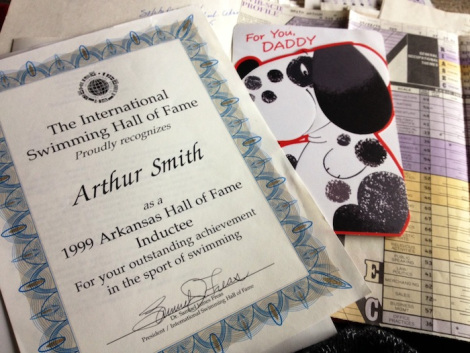
The letterhead stated Arkansas Swimming Hall of Fame.

It said,
“Dear Arthur, as you know, because of your outstanding contribution to the sport of swimming in the state of Arkansas, you have been inducted into the Arkansas Swimming Hall of Fame.”

Whoa. Hold up. Dad, this is a BIG DEAL. Why didn’t you tell me about this??

The letter went on to talk about my dad’s swimming career, most of which I already knew, but when it was there, printed on this formal letter, it made my eyes go wide, my heart swell with pride.

Dad, you were the dark horse, the unheard of swimmer who somehow conquered it all. You were nationally ranked, a five-time All American. You were a champion.

You were so much more than a swimmer, Dad, but I am so proud that you didn’t let your inexperience in the swimming world hold you back. You did it. You worked so hard and you made your mark.

So with this mysterious folder, business was off to a good start. But who knew what else was buried in the pile.

Mechanically, I reached for the next thing in the stack- a card “For a Son Who’s Loved So Much.”

It was a “just because” card from my dad’s mom, who I called my nana.

Nana and I weren’t super close. We never really had the opportunity to be, living more than a thousand miles apart. To tell you the truth, I always thought that I would never be able to relate to her – a sophisticated Southern woman and me, a prank-loving, spontaneous-dancing, free-spirit child.

But reading her words allowed me to learn more about my nana –and her relationship to her son, my dad- than I had ever known.

“Words cannot express my love for you – it grows every year, if that is even possible. How I cherish the loving memories of your childhood (rosy red cheeks that looked as good as apples)… You are my Guardian Angel.”

Wow, Dad. You and nana must have been really close. I know I didn’t know her very well, but she really loved you. I’m so glad that you were so loved by your mom – that she thought the world of you. Because you so deserved that, Dad. You really did.

The next few things were business documents that didn’t mean much to me,
but behind those pages were what I had been hoping for, yet not hoping for,
the really personal stuff.

The stack of cards that I was holding in my hands wasn’t just my dad,
it was my mom, too – letters she had written him from their nearly 15 years of marriage.

I tell you, this folder was the most beautiful gift.

I learned a lot about my dad,
about some things that he was too humble to share,
about him as a son and as a husband,
a man who was deeply loved, deeply passionate, and all together, deeply deep.
Yup. That was my dad. One deep dude.

I finished reading the cards and closed the folder, only wishing that there had been just a few more cards, a few more keepsakes or napkin-scribbled notes that could bring more of him back to me.

When you lose someone you love, there are
days when your heart is heavy,
days when you just need a good cry, or scream,
days when you are angry at their not being there,
days when your memories of them bring you this amazing warmth,
days when you shout thanksgiving praise that you even got to know them at all.

Then there are days like this one,
when you receive the blessing of a mysterious file folder, filled with things you never would have asked for -had a genie granted you five wishes- and you find yourself rolling on the floor, laughing, thinking that

I have the best dad ever. Thank you, God. Thank you for this moment, too. I will always remember it. I will always remember you, Dad.

Love, Taylor